Sunday, 4 October 2015
Let Go Kickstarter successful!
Let Go, a futuristic graphic novel I'm drawing for writers Jon Perry and Ted Kupper (of the Review the Future podcast) was successfully funded on Kickstarter (YAY!) Thank you to all who contributed. Jon, Ted and I will make our best to deliver you the best product possible.
You can read the first 16 pages of Let Go here.
Monday, 20 February 2012
Article about The Boar

Maria Grazia wrote a super-interesting article about my comic, The Boar, praising me so much that I'm humbled. That's what she wrote:
The historical facts, battles and politics, are just hinted at: it is mainly a romance made up of flashes with many shifts in time. If a flaw must be found in this beautiful , original graphic work it is that someone who does not know the facts may feel lost and disoriented. But it is such an atmospheric, gripping tale that they may be lead to search and discover more about this fascinating character: "Dickon", the man who will become Richard III.
An interview for the same blog will be published soon. Thank you! :D
Wednesday, 28 December 2011
Community Service
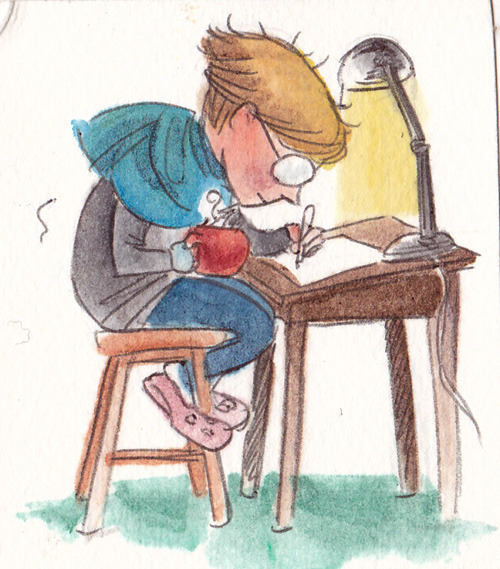
Me working in the cold!
I've started working on a new project with writer Dino Caruso. It's for a graphic novel called Community Service. The story is outstanding, and I'm thrilled that Dino chose me to illustrate it. You can read more on Dino's blog.
the very first sketch for the protagonist, Drummond.
Friday, 1 April 2011
Balloons sketchdump
Wednesday, 30 March 2011
Balloons preview
Saturday, 6 November 2010
reading comics: memories 1
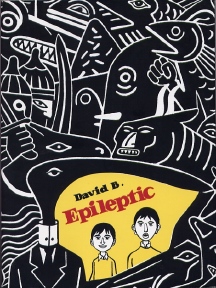
It is a strange book. Some pages are fantastic, other are awful (especially in the first half), from a comic book point of view, because it's too often the captions that carry out the narration, and too rarely the drawings. The majority of the book seems to me more like an illustrated novel than a comic book of graphic novel or as you wish to name it. I mean, the drawings alone aren't able to tell the story. They are too fixed, too rigid, there's no much dynamism in them. Dialogues are too few (even if they increase in the second half) and captions are too many. Of course David B. uses these strategies on purpose to create a story that feels as heavy as the epilepsy Jean-Christophe suffers of. But this book is just on the verge of the works that make me wonder what was the point of in making them under a graphic form instead than just a written one.
Even if I've read comics since I was a child, the residency at ACA and the last week at home have been the period in my life in which I've most thought about comics - from a theorical point of view, and not just from the perspective of a reader/author of a specific piece.
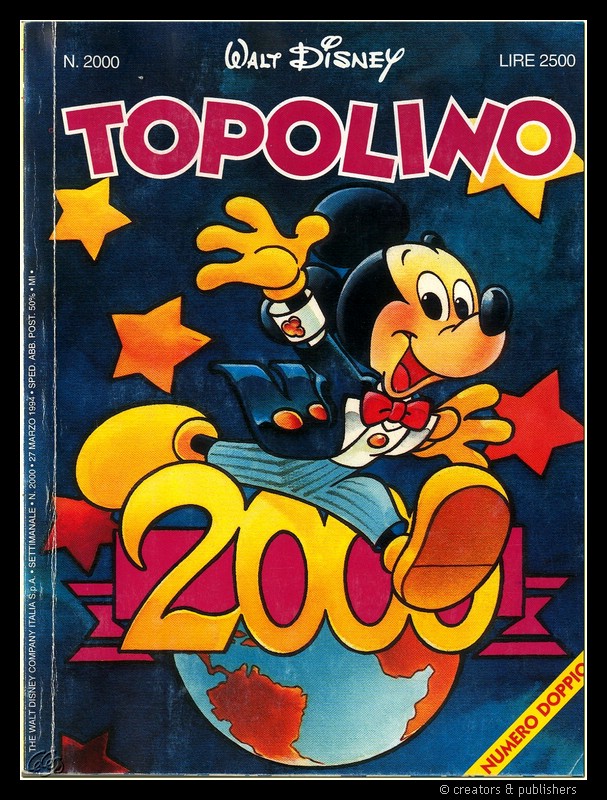
When I was a child, I regularly read three comics magazines (in Italian), plus other children's magazines which contained comics as well. The first was the Corriere dei Piccoli. It featured stories like Stefi by Grazia Nidasio and I Ronfi by Adriano Carnevale. The second was Topolino (= Mickey Mouse), which contained stories from the Disney world written and drawn by Italian artists. I suppose that almost all Italian children of the last 50 years have held a copy of Topolino sometime.
the famous n. 2000
Aside from these magazines, as a child I read The Peanuts, Mafalda, Asterix, and I was given as a present the abridged versions of I promessi sposi by Paolo Piffarerio and of Shakespeare (Hamlet, Romeo & Juliet, The Tempest) by Gianni De Luca.
At 12 I read - during a summer camp - my first episode of Dylan Dog (now published by Dark Horse also in the States) and continued reading it for a couple of years, until, at 14, I surrendered to a friend's entreaties and started reading Rayearth by Clamp, my first manga.
1 - continues...
Wednesday, 3 November 2010
Comics and literature
what can comics do that literature can't?
In some graphic novels (especially in some autobiographical works), the predominance of text over drawings seem to me so evident that I start to question the need, from the author, to tell that story with some kind of visual accompaniment instead than just with plain words. Why bother to draw panels if your captions already tell all the story?
Literature can make everything possible. With words, you can create feelings, worlds, characters, actions, emotions. There’s almost no limit to what a piece of written words can make you imagine. But, on the other hand, what can a comic do that a novel can’t? What are the inalienable specificities of the comic medium?
Comics can create a character visually in way that just written words can't. If you find in a novel a description of a "young woman, with black hair tied back, green eyes and a quiet attitude", how does exactly this woman look like?
Another specificity of comics (and of illustrations in general) is to produce an immediate impression on the viewer of the overall situation, that can be then fragmented into details, while a written description produces an overall impression only at the end of it. If you read the paragraph,
"Her desk was covered with books and stuff. Empty mugs were placed everywhere, on the desk and on the bookshelves behind, and a bottle of water was always within reach. Old cans of coffee were reemployed as penholders. Paper sheets, both new and used, were piled around the one sheet she was curretly working on"the overall impression will form in your mind only when you finish reading the description. On the other hand, with a drawing, the overall impression precedes the distinction of details:
A drawing will help you establish the precise look of the world you have designed:
and it will direct the eye of the reader in the direction you want, leading the view through angles and perspective.In a comic you can show characters' emotions from the outside, through their expressions:
telling, if you want, the exact way your characters react to something. This creates a sense of drawn life, or, if you prefer, drawn theatre.