Showing posts with label influences. Show all posts

Saturday, 14 April 2012

Draw anything

One of my favourite comics ever is The Calling by Reiko Okano, an adaptation of the novel The Forgotten Beasts of Eld by Patricia A. McKillip (in Italian, La maga di Eld). I fear that Okano's adaptation has never been translated into English, but it would be totally worth it. You can read an article about it here.

Okano's drawings are the very essence of lyricism, ethereal-ness and otherworldliness. I was as in awe when I first read it, ten years ago, as I am today. I wish it was universally considered a masterpiece.

In her afterword to The Calling, Okano writes that she first read The Forgotten Beasts of Eld when she was almost 20, and that it was the novel that pushed her to become a mangaka.

"To achieve my dream [to give a visual dimension to McKillip's novel], I will become a comic book artist, and to master the art of drawing, I will illustrate anything, no matter its subject." So I took this decision, and for the next 10 years I drew any kind of subjects, from monks to sumo wrestlers. Being able to represent those magical beasts became closer little by little.

Okano's words came back to my mind. In the last eight months, I've drawn things I'd never thought I would draw before. I was extremely lucky in that. Although you've been able to see only a small portion of what I've drawn during this year, I know that it has made me a better artist than I was before. And this was able only because of the people who trusted me with their works, and whose I have to humbly thank.

I know that, during this period, I've almost stopped drawing my own stories and sparse illustrations. I know. It's not that I wouldn't like to do them again. But I'm training to make them better one day, hopefully. I also needed some time without personal involvement in what I was drawing. Please follow me in my journey.

Monday, 13 December 2010

Belated Fanart Friday

Last Fanart Friday was dedicated to our great master artist, Craig Thompson, an artist to whom I owe too much to be described. Unfortunately tumblr bitching prevented me from posting my images on time, and during the weekend I dedicated myself to other things. So, with a bit of delay, here is my due tribute to the man who allowed me to fly to Florida.

Photobucket

Photobucket

These are the first two pages of a 4 pages comic I did back sometime around 2006, clearly under the influence of Craig's brushwork. It was probably the first time I inked a comic with a brush, and actually the flow of some details amazes me still now, considering that I tend to segment my lines even with a brush.


This is a simple joke I did after coming back from the ACA. We saw a lot of pelicans during our boat trip on the Indian River. The Italian sound for crows and other kinds of birds is "Cra" and I mixed it with Craig's name. Therefore, Peli-craig.

Thank you for everything, Craig.

Saturday, 6 November 2010

reading comics: memories 1


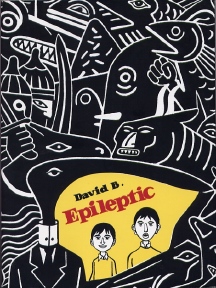
Today I finished reading Epileptic by David B. I started reading it in Florida and yesterday I bought a copy in Italian to finish reading it. In one day I read more than 200 pages.
It is a strange book. Some pages are fantastic, other are awful (especially in the first half), from a comic book point of view, because it's too often the captions that carry out the narration, and too rarely the drawings. The majority of the book seems to me more like an illustrated novel than a comic book of graphic novel or as you wish to name it. I mean, the drawings alone aren't able to tell the story. They are too fixed, too rigid, there's no much dynamism in them. Dialogues are too few (even if they increase in the second half) and captions are too many. Of course David B. uses these strategies on purpose to create a story that feels as heavy as the epilepsy Jean-Christophe suffers of. But this book is just on the verge of the works that make me wonder what was the point of in making them under a graphic form instead than just a written one.

Even if I've read comics since I was a child, the residency at ACA and the last week at home have been the period in my life in which I've most thought about comics - from a theorical point of view, and not just from the perspective of a reader/author of a specific piece.

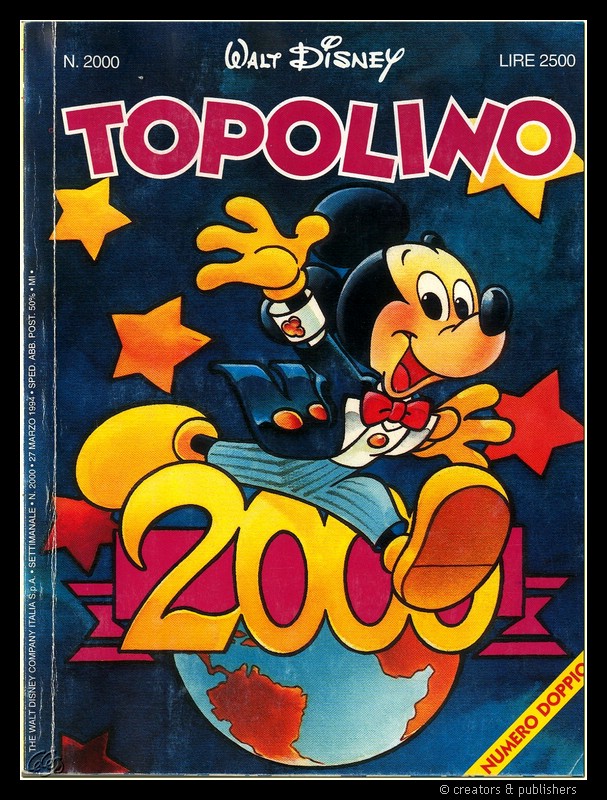
When I was a child, I regularly read three comics magazines (in Italian), plus other children's magazines which contained comics as well. The first was the Corriere dei Piccoli. It featured stories like Stefi by Grazia Nidasio and I Ronfi by Adriano Carnevale. The second was Topolino (= Mickey Mouse), which contained stories from the Disney world written and drawn by Italian artists. I suppose that almost all Italian children of the last 50 years have held a copy of Topolino sometime.


the famous n. 2000

The third was Il Giornalino, that in summer published as enclosures the comics adaptations of great classics of literature, such as Little Women, Oliver Twist, Taras Bul'ba, etc. As far as I know, this practice of publishing abridged versions of classics for children, under the form of comics (but today they'd be called graphic novels) is a specific of Italy (correct me if I'm wrong).

Aside from these magazines, as a child I read The Peanuts, Mafalda, Asterix, and I was given as a present the abridged versions of I promessi sposi by Paolo Piffarerio and of Shakespeare (Hamlet, Romeo & Juliet, The Tempest) by Gianni De Luca.


These were not just comics. These were work of art and could be stared at just for the pleasure of watching something beautiful. Piffarerio (who collaborated also with the main Italian magazine of cross-word puzzles, La settimana enigmistica, illustrating rebus) was a master in drapery, while Gianni De Luca, well, he would later become one of my main influences in thinking comics.

At 12 I read - during a summer camp - my first episode of Dylan Dog (now published by Dark Horse also in the States) and continued reading it for a couple of years, until, at 14, I surrendered to a friend's entreaties and started reading Rayearth by Clamp, my first manga.


After that I read only mangas for many, many years.

Comics, of course, were not the only texts I read. In the meantime, I have been reading also traditional, written literature. And before now, I had never seen comics and literature as opposed to each other. In my head, they were quite different. And maybe I used them in different ways, I mean that I read them in different situations and in different conditions. Now I have to confess that maybe, inconsciously, I considered comics a lighter reading than novels and plainly written works. They were for entertainment - and what a gorgeous entertainment they provided! Mangas seemed created to start fangirlism in a young girl as I was when I started reading them. Manga were made to discuss them with friends and to fall in love with handsome characters and to buy posters and photos during comic-conventions. They are able to stir deeper emotions in a reader than the average Western comics. Long stories presented an abundance of characters and each was clearly defined. In mangas you could follow psychological transitions from imperceptible details. That's why one of the funniest things I know is chatting about "what happens next" in our favourite mangas with my friends. And that's why I imagine my main comic project, Asanor, as a manga, even if it's drawn in Western style. I imagine it published in episodes during a few years and only later, eventually, collected in a few volumes. I dream about people talking about my characters and what they will and won't do and waiting for the new episode to be out in comics stores.

1 - continues...