Showing posts with label Asanor. Show all posts

Tuesday, 17 July 2012

Saturday, 12 March 2011

Happy birthday Miriel

Photobucket

March 12 is the birthday of Miriel, one of the main characters of my ever-going saga, Asanor. Yes, she has green hair, the result of being the only child without magical powers of a magical family.

Watercolour pencils and watercolour on Langton Prestige. It's the first time I use this paper.

Tuesday, 8 February 2011

inks, nibs, Asanor & Hook

Photobucket

This is the first picture I ink with the new Hunt #108. The brand new brass surface had difficulties in keeping the ink, and it also seemed harder than the previous (now broken ç_ç) nib. At the beginning I had to dip the nib in the ink bottle almost every centimetre. I had almost finished inking when the nib started to be dirty enough to behave as I expected.

Anyway, this is my usual clutter when I try to ink in a clean way - I don't know, but I always get less interesting results when I try to be clean. Moreover, I'm still unsatisfied when I try to place deep blacks.

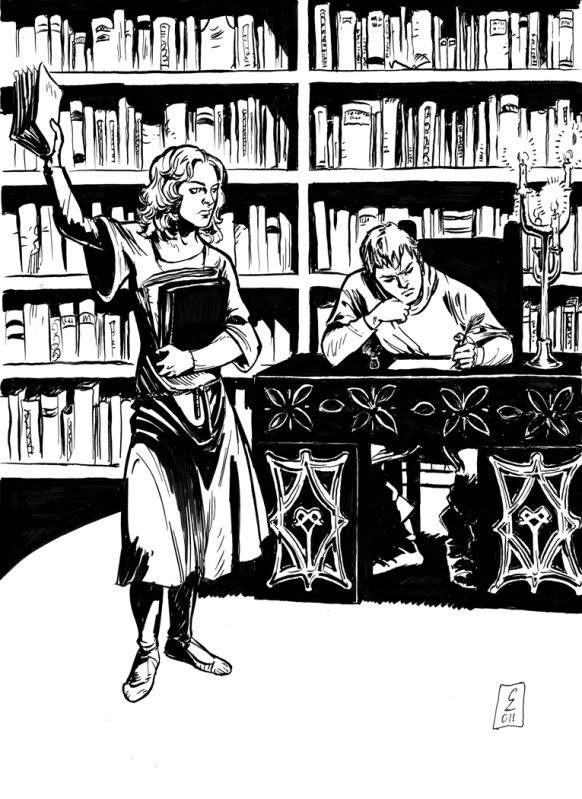
This drawing, in any case, was intended to show two main characters of my saga, Asanor: the protagonist (on the right) and his love interest, Miriel (on the left). She is the daughter of a typographer, hence their well-equipped bookshelves.

Photobucket

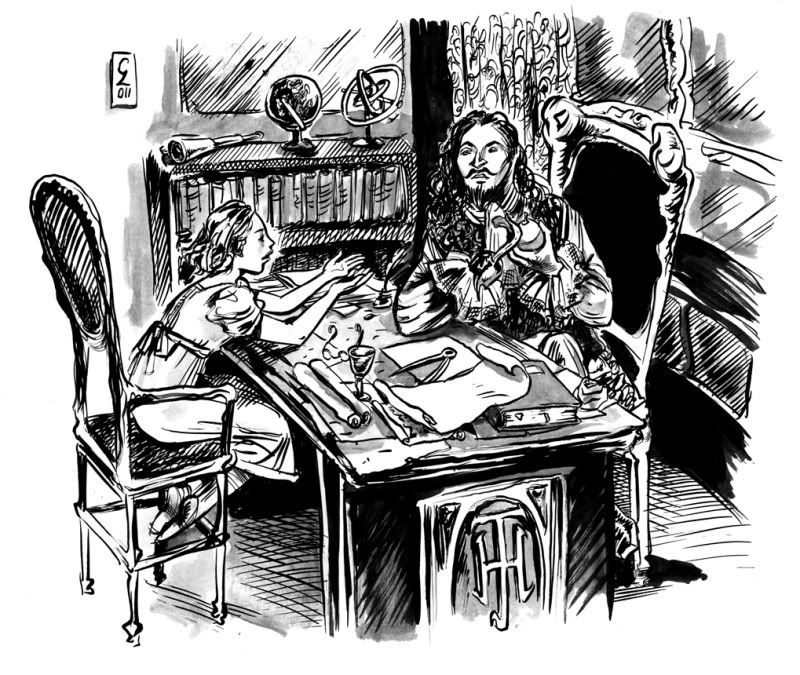
This, instead, is the last drawing I inked with the late #108. It's Hook peeling an apple for Wendy. You could tell I had just re-watched the Peter Pan movie with Jason Isaacs (squee). What you couldn't tell, since I adjusted the level, is that it was inked with a Lefranc & Bourgeois Chinese Ink, bought in Angoulême. It's a truly dreadful ink, if I may say the truth. I heard that people call the Pelikan ink a diluted wash; it only means they haven't tried the Lefranc & Bourgeois, because, meh, this is dirt water with a drop of black, not an ink. The only pro is that it's extremely flowing; but it's way too clear, almost grey, not pitch-black.

Sunday, 23 January 2011

Angoulême, presque


Theo Turnese by *cabepfir on deviantART

Sometimes I remember to scan and put online drawings that weren't drawn and uploaded at once. This Theo has been drawn in Florida, during the ACA residency. One of the first drawings to be inked with my fabulous Hunt #108 Flexible Quill.

On Tuesday I'll leave for Angoulême, France. I'm excited and terrified at the same time. What is sure - I am not prepared as I should. Easy guess.

Thursday, 13 January 2011

Un rumore nella foresta


Un rumore nella foresta by *cabepfir on deviantART

This is from Asanor. Asanor is my fantasy saga, built inside my head since 1998. I also draw a first draft of it from 2002 to 2005, which ended at page 948. One day, hopefully, it will be re-drawn properly.

As for the moment, the whole saga runs like this:

  1. Asanor (the main tale, about 1000 pages long)
  2. A collection of short stories, namely:
  • The summer when Jibras turned eleven;
  • The pinewood of Sevonell;
  • How sprung the thorns of the roses;
  • War between siblings;

all these stories are prequels to Asanor.

3. The nine temples of Royke (second tale, sequel to Asanor, another 1000 pages, more or less ;)

The characters in the drawing here above are Asanor (in the background) and his best friend, the elf Dwenn. I don't know what they're afraid of.

Wednesday, 5 January 2011

Happy New Year!

I'm awfully late for New Year wishes, but unfortunately I don't have a scanner in the house where I spend my holidays. In any case, I can assure you that these three drawings have all been drawn and inked well before the New Year's Eve, and so it is only the uploading that has been delayed.

Photobucket
A girl I saw in the girls' toilet of a pub I went with my friends on Christmas day.

Photobucket

From the time when they were happy - Theo and Gaveston, two characters from the Asanor universe.

Photobucket

Their character design has quite changed from the first time I drew them - I still have troubles in visualizing exactly how Theo's nose and face should be.

A very merry 2011 to you all.

Saturday, 6 November 2010

reading comics: memories 1


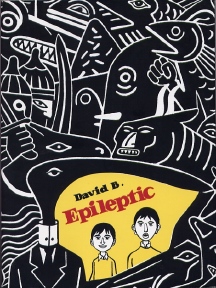
Today I finished reading Epileptic by David B. I started reading it in Florida and yesterday I bought a copy in Italian to finish reading it. In one day I read more than 200 pages.
It is a strange book. Some pages are fantastic, other are awful (especially in the first half), from a comic book point of view, because it's too often the captions that carry out the narration, and too rarely the drawings. The majority of the book seems to me more like an illustrated novel than a comic book of graphic novel or as you wish to name it. I mean, the drawings alone aren't able to tell the story. They are too fixed, too rigid, there's no much dynamism in them. Dialogues are too few (even if they increase in the second half) and captions are too many. Of course David B. uses these strategies on purpose to create a story that feels as heavy as the epilepsy Jean-Christophe suffers of. But this book is just on the verge of the works that make me wonder what was the point of in making them under a graphic form instead than just a written one.

Even if I've read comics since I was a child, the residency at ACA and the last week at home have been the period in my life in which I've most thought about comics - from a theorical point of view, and not just from the perspective of a reader/author of a specific piece.

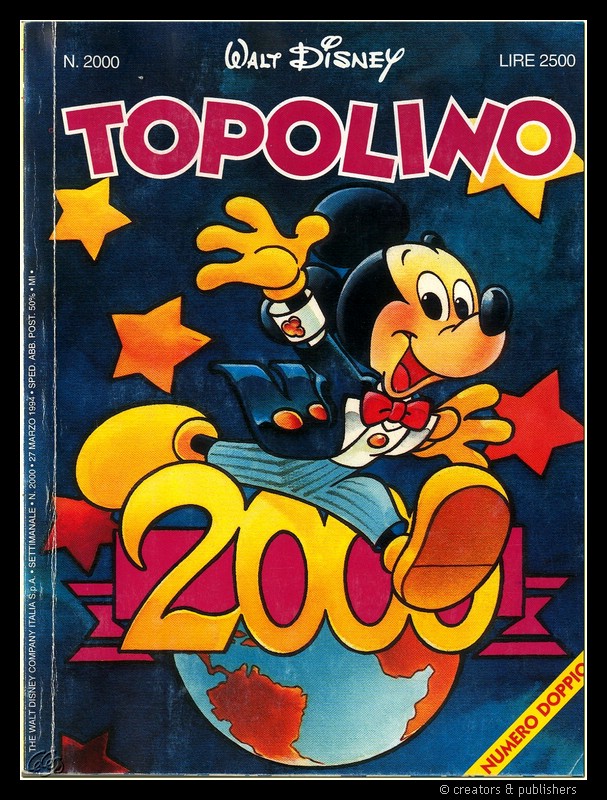
When I was a child, I regularly read three comics magazines (in Italian), plus other children's magazines which contained comics as well. The first was the Corriere dei Piccoli. It featured stories like Stefi by Grazia Nidasio and I Ronfi by Adriano Carnevale. The second was Topolino (= Mickey Mouse), which contained stories from the Disney world written and drawn by Italian artists. I suppose that almost all Italian children of the last 50 years have held a copy of Topolino sometime.


the famous n. 2000

The third was Il Giornalino, that in summer published as enclosures the comics adaptations of great classics of literature, such as Little Women, Oliver Twist, Taras Bul'ba, etc. As far as I know, this practice of publishing abridged versions of classics for children, under the form of comics (but today they'd be called graphic novels) is a specific of Italy (correct me if I'm wrong).

Aside from these magazines, as a child I read The Peanuts, Mafalda, Asterix, and I was given as a present the abridged versions of I promessi sposi by Paolo Piffarerio and of Shakespeare (Hamlet, Romeo & Juliet, The Tempest) by Gianni De Luca.


These were not just comics. These were work of art and could be stared at just for the pleasure of watching something beautiful. Piffarerio (who collaborated also with the main Italian magazine of cross-word puzzles, La settimana enigmistica, illustrating rebus) was a master in drapery, while Gianni De Luca, well, he would later become one of my main influences in thinking comics.

At 12 I read - during a summer camp - my first episode of Dylan Dog (now published by Dark Horse also in the States) and continued reading it for a couple of years, until, at 14, I surrendered to a friend's entreaties and started reading Rayearth by Clamp, my first manga.


After that I read only mangas for many, many years.

Comics, of course, were not the only texts I read. In the meantime, I have been reading also traditional, written literature. And before now, I had never seen comics and literature as opposed to each other. In my head, they were quite different. And maybe I used them in different ways, I mean that I read them in different situations and in different conditions. Now I have to confess that maybe, inconsciously, I considered comics a lighter reading than novels and plainly written works. They were for entertainment - and what a gorgeous entertainment they provided! Mangas seemed created to start fangirlism in a young girl as I was when I started reading them. Manga were made to discuss them with friends and to fall in love with handsome characters and to buy posters and photos during comic-conventions. They are able to stir deeper emotions in a reader than the average Western comics. Long stories presented an abundance of characters and each was clearly defined. In mangas you could follow psychological transitions from imperceptible details. That's why one of the funniest things I know is chatting about "what happens next" in our favourite mangas with my friends. And that's why I imagine my main comic project, Asanor, as a manga, even if it's drawn in Western style. I imagine it published in episodes during a few years and only later, eventually, collected in a few volumes. I dream about people talking about my characters and what they will and won't do and waiting for the new episode to be out in comics stores.

1 - continues...